Showing posts with label SNES. Show all posts

Wednesday, 14 January 2015

Retron 5 mini opinion.

Despite arriving well over a year late, at least in the EU, I finally got to try the Retron 5 last night and it did not fail to deliver.

First impressions were certainly mixed. The system is weird looking, as to be expected with so many cartridge slots. It's also feels lightweight and rather cheap, albeit solid in construction. The control pad is pretty poor and does lose connections from time to time but no retro gaming fan would use it when you can use Mega Drive, SNES or NES pads.

I spent about two hours with the Retron 5 last night and came away wanting one for myself. It runs a clean operating system with the usual emulator based options such as scaling, image size, region, force 60hz and the most important, scanlines. Scanlines add the black lines last seen many many years ago when it took multiple people to move a television from one room to another, when these systems the Retron is emulating were cutting edge.

The system was already set up before I played it so I cannot comment on any issues there, but the menu system was very intuitive to use and clean.
The first game I played was Super Mario Kart, a Mode 7 based game which doesn't run at all well on some systems such as a modded PSP.


Super Mario Kart ran superbly and looked lovely. I quickly forgot I was even playing an emulator device due to holding a genuine SNES pad in my had. The frame rate held up perfectly and was virtually indistinguishable from the original. Sound was also excellent.

Next up I put on Street Fighter 2 Turbo and it looks amazing. Easily better than using real hardware on a HDTV.  The sprites were wonderfully crisp and sound timing was pretty much spot on, an issue I had when trying to get the JXD to run SNES games.

I quickly moved on to the main reason I personally wanted to play on this system, Gameboy and GBA. I own a Super Gameboy and it is very good. Sadly is does not support enough later games, particularly colour exclusive games. I used to own the Gameboy Player on GC and frankly it's a load of rubbish. It forces the resolution to 480i which turns all Gameboy games into a flickery mess on the TV. It's a complete comedown after playing on the super sharp GBA screen, especially the Micro or AGS 101.
So, the Retron was the best chance of crisp and vibrant GB action and it delivered way above what I expected.


Metroid Fusion seen here in a slightly blurry picture looked absolutely incredible. The pixels were sharp, the colours blew out from the screen and it ran perfectly. Also the sound was excellent, something you cannot really get the most out of with a portable unless you use headphones. It controlled superbly, again with the SNES pad and seemingly ended my own personal wait to play these games on the big screen. 

Also popped on Revenge of the Gator which looked crisp and ran smoothly and after a recent update, allowed you to choose which colours you want to play in, much like the Super GB.

Finally I popped on the Mega Drive and it ran just as excpected. The MD is a much easier system to emulate than the SNES and GBA and as expected there weren't any real issues. The image was as crisp and the gameplay as smooth although I did use a SNES pad again.....


You can see here just how sharp it is, the only decent shot I took last night. All the games I played including the Gameboy ones were this sharp. It looks utterly sublime.


I haven't spent masses of time with it but the vast majority of games I am told work fine. There is an issue with it clearing battery saves which I wonder has anything to do with inserting carts while the machine is turned on. It certainly works differently from real hardware but once in game, it feels very real.

It was tested on a 55'' 4k television and still looked absolutely amazing. No scaling issues at all. I have no idea what the Retron 5 outputs as standard and if there is an option to change it, I didn't look to be honest. All I can say is that it looks better than real hardware when running through a HDTV. The only way real hardware will look as good as if you invest in a scaling device such as the Framemeister.

If you exclusively play games on a HDTV then I completely recommend it, especially if space is at a premium. If you are lucky like me and have a CRT in your lounge then it's not worth it, unless you want full screen GB action, It is probably worth waiting for the price to drop a little. For me I would pay around £100 for something like this as the current £130 price is a little high for something that comes with such a poor controller and the cheap feel to the plastic.


@nakamuramartin


Monday, 29 September 2014

Martin and Darran play games, properly! Week 1.

After becoming increasingly disinterested in the path modern games are taking, myself and Darran Jones of Retro Gamer magazine decided to make a concious effort to play more games together from days gone by.
Our main interest in recent times lie with the golden 16 bit era. Darran has a growing Mega Drive collection containing some superb shooters and arcade games and I have a NTSC SNES collection with almost 100 CIB classics.

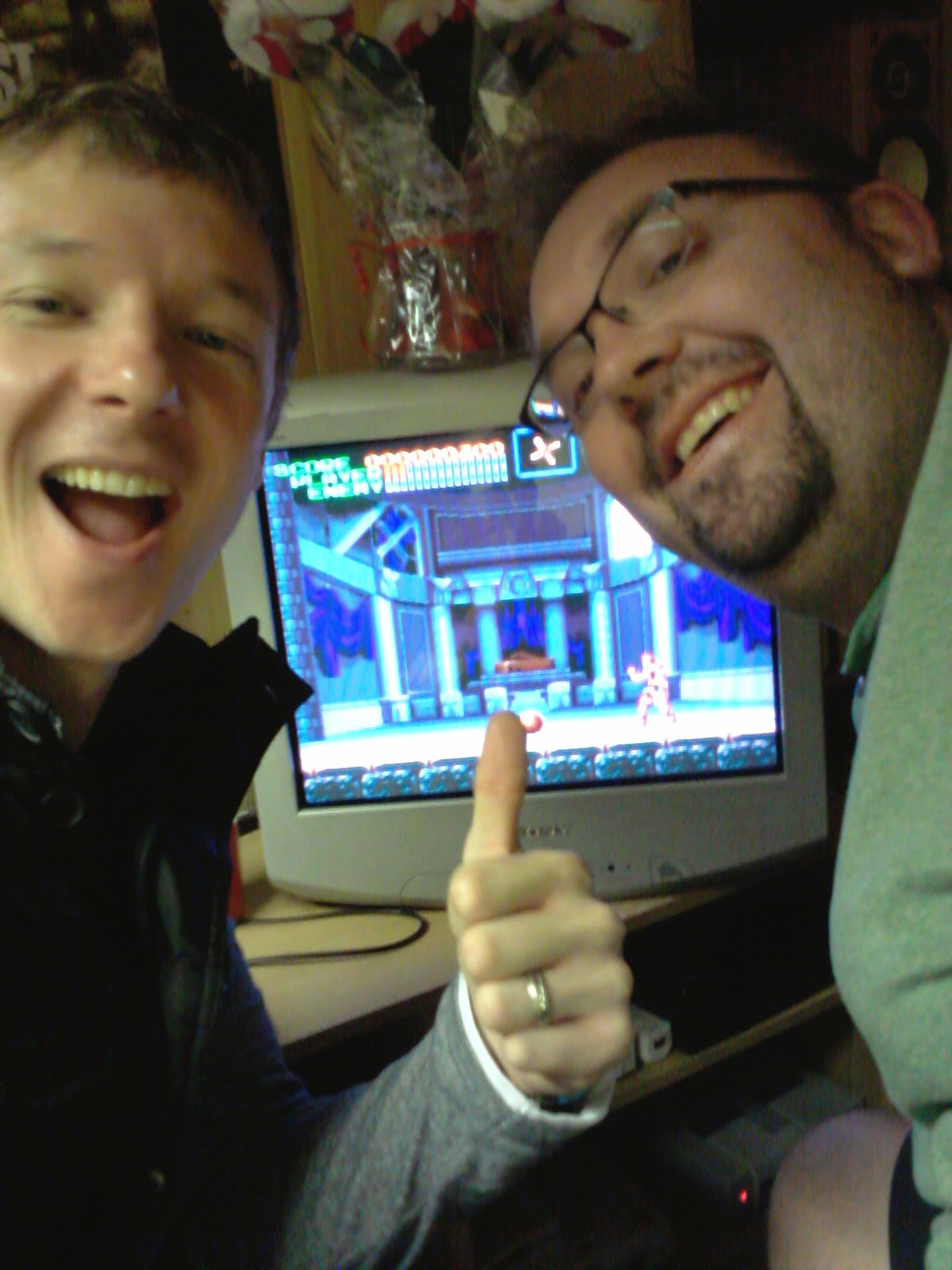
Our first game night accidentally consisted of a full playthrough of Akumajou Dracula on the Super Famicom, aka, Super Castlevania IV.


Originally, I took over a selection of action games for us to play together but I threw this on while Darran was thumbing through his latest bird pictures on his PC. It was only meant to be a quick go but a combination of the pin sharp image on the Sony CRT, and the immense soundtrack pumped through the Sony stereo I bought for Darran on his 40th birthday kept us hooked.


As many know, Super Castlevania is a classic so I wont bore you with the details and 'review' the game. However I will highlight the importance of having the right set-up to really enhance your gaming.
With a game like Super Castlevania IV, you are really missing out if you play it using only a TV for sound. The stereo takes the game onto another level as the soundtrack is perhaps one of the best of all time. It still sounds amazing, even today.
The sound designers used a huge range of sampled instruments and the depth of the soundtrack astounding, especially when you factor the machine only has 8 sound channels.
The bass is enhanced tenfold too, when hooked to a decent sound system, it really shakes the room on some levels.

The next component may not seem too obvious, playing with a friend, or in this case, a cousin, and enjoying a game together! Even with a game like this which isn't multiplayer, we still had a blast. As many gamers have gotten older, either time has become harder to come by or many have migrated to online gaming. However I urge people to arrange nights like this.


Once the game kicked off and the amazing atmosphere dragged us in , we played with the classic one life each system. I cannot remember the last time I played a game like that, many many years ago.
As the game progressed we delighted in the little details of the caverns in level 3. Marvelled at the incredible rotating room of level 4 and held our breath as we approached the castle at the end of the short but gripping level 5.


By the time we reached the midpoint of level 6, the swinging chandeliers, we were completely high on nostalgia and lost control of ourselves.


Ahem.


By this point, we realised we hadn't had as this much fun in a long time.
We started to find a pattern in our gaming abilities. Darran was clearly better at tackling bosses and I could negotiate the trickier platform sections, especially the vanishing platforms in the 8th level, the cellar.
Another handy aspect of playing alternatively is we could spot patterns and tactics when in tough situations, it really did help.

We ploughed on and managed to complete the game after about 3 hours play time. That Dracula fight remains an outstanding moment in gaming, truly cinematic despite only being 2D. Truly one of the best games of all time.


Stay tuned for more gaming including Thunderforce III, Pieces and Contra Spirits!


Monday, 1 July 2013

Ten Imperfect Tens part 2.

Here I have the second part of my inperfect tens feature. Enjoy!


Capcom vs SNK: Millenium Fight 2000. 

While this may not be the connoisseurs choice, that honour usually goes to Street Fighter 3 or Garou, I find Capcom vs SNK to be the finest fighting game ever made.
Released in 2000 for arcade and Dreamcast and later ported to PS1 with decent results, Capcom vs SNK was the first Capcom developed game in the VS series of games between the two companies.

The game features a huge roster of characters from both the Street Fighter and King of Fighters franchises and two fighting systems. Each character has a ratio level from 1-4 and you can select a team that contains up to 4 ratio points. After selecting characters you choose your fighting style, Capcom or SNK.

The two fighting systems have fairly minor differences but they change the approach of the play somewhat. The Capcom system features the three level super gauge. This charges throughout play when attacking or taking damage and when at least one level has been filled, you can activate a super move. Fill all three levels and you can access three level one supers or a level three super move which is crazily powerful.
         The SNK system differs a little, it features a charge based system. You hold the hard punch and kick buttons to activate the charge at any time. Once full it slowly decreases until empty and in this time you have access to a level one super. The biggest difference is the desperation attacks. When energy is low your bar flashes and you have access to a level one super at any time. Combine this with a maximum charge and you have a level three MAX super available to use.

The gameplay itself is superbly balanced. It features dashes, jumps, high jumps, chain combos, tech throws and more. There is an excellent speed to the game and the fighting is ultra responsive. It feels like a balance between the King of Fighters/Street Fighter Zero games and the Street Fighter III/Garou titles. Plenty of depth due to the ratio system and mixed fighting styles but not too deep that only the hardcore need apply.

The presentation is without doubt the best in the genre. The stages have loads of cool introductions and the 2D backgrounds are fantastic and overall the animation is superb. Music is absolutely pounding and flows with the game so well. When you win a bout, the music flowing into the next one starts immediately on connection of the finishing blow. It pumps you up in anticipation for the next match.

The main annoyance of Capcom vs SNK is with the sprites themselves. They are lower resolution than the lovely backgrounds and can look scruffy as a result. Also the Ryu/Ken sprites were redrawn for the game and suit the SNK style really well. The rest of the Capcom characters are taken straight from the Zero titles and look too cartoony as a result.

Capcom vs SNK is a fighters dream. Accessible, amazing presentation and superb balance to the gameplay. It has kept me playing than any other single title within the genre.


The Legend of Zelda Skyward Sword.

There is always a huge debate of which Zelda game is the best but this one has taken things to a new level for the first time since Ocarina of Time.

Skyward Sword tells a much more cinematic tale compared to other games in the franchise and has some fantastic cut scenes as a result. It's told as a story of origin for the franchise and again manages to be relatively fresh despite featuring mostly the same cast of characters as ever.

The game uses a lovely pastel visual style which is vibrant gives off a lovely warm feel. It straddles the style of Wind Waker and Twilight Princess nicely. The music is also fantastic, the theme of Fi being a stand out track.

The gameplay is where Skyward Sword stands not only above other 3D Zelda titles but above other third person adventure games. While the overall basics are similar to every other game in the franchise, the Motion Plus led combat is not and brings a new level of immersion to the game.
The Motion Plus controller mimics your every move on screen, pretty much 1-1 tracking. When you stab, Link stabs. When you swipe, Link Swipes and he always swipes in the directions you swipe in.
While this is simple in itself, it's the clever enemy design that takes it further. Some enemies will guard with shields so you need to find a way past them. You can use your sword to make them follow your blade with theirs until they leave a gap. When this gap appears you need to swipe in the appropriate direction, it works really well. There are plenty of different enemies that require different strategies to defeat.
The Nunchuk is also used to parry with the shield. In certain sections, a few boss fights for example, the game feels like a full on sword fighting simulator. When you are parrying with the shield and counter attacking with the blade it really draws you in and immerses you so much more than with a controller.

Skyward Sword is a long game too, up to 40 hours for the story alone. There are also plenty of things to find, mini games to complete and side quests to do.

There are a few sticking points though. The opening two hours are far too slow and every time you continue the game, you have to read the same bug/rupee collection signs which is extremely annoying. Once would have been fine!

Skyward Sword is a 9/10 game with a controller, with Motion Plus it takes it to the next level, to a 10. On a game design front it is fantastic but certainly nothing new, the Motion Plus ramps up immersion ten fold and makes it easily the best Zelda game since Ocarina of Time and its superb Z targeting system.


Grandia

Released in 1997 for the Japanese Sega Saturn, there was outcry when there were no plans to bring the game to the west. We had to wait September 1999 to play the game in English after it was ported to the PS1 but boy it was worth it.

Grandia is charming, it's probably one of the most if not the most charming game ever made. The characters are just superb. They manage to pull off the serious, the dangerous and the downright slapstick without ever looking out of place. The main character Justin, spends a large portion of the game larking around, trying to be an adventurer like his father and as a result gets into some funny situations such as a wedding hijack. Sue is his eight year old sidekick and manages to be cute without every being annoying. She also has a weird creature that lives in her hair called Puffy. There are a host of other characters too all with great back stories and motivations, all of which fit together in perfect harmony.

The battle system is perhaps one of the best in any RPG. It's semi time based and semi real time. All characters and enemies move along a bar until they reaction the action zone. Once there, a move is selected and then it needs a little more time to perform. Each move takes a different amount of time, often the more powerful the slower the time it takes. There is plenty of room for strategy here as you have to balance the moves depending on enemy actions. You can cancel an enemy attack with good timing too so it presents a lovely risk/reward system. Battles never feel a chore which is vital in an RPG.

Visually it's fully 3D which is rare during a time when games were often using pre rendered backgrounds. The game looks stunning and there so many incidental details such a falling broomsticks and hanging lights, each area feels like it has been crafted with real love.
Characters are drawn using sprites and work well with the backgrounds and the animation is great too.
Music is also wonderful, easily the best soundtrack by Noriyuki Iwadare. The main theme is so wonderfully triumphant, it cannot fail to stir even the most grumpy of gamer.

Grandia is such a wonderful game it feels someone wrong to pick holes in it but there are issues. The PS1 version, the one most of us will play does suffer from slowdown at times. The battle scenes uses flat 2D images which are quite blurry on PS1. Also even with the Saturn version, the 3D can look scruffy in places and the frame rate chugs a bit.

Grandia has no random battles, buy it now!


Super Tennis. 

Twenty two years after Super Tennis came out, it is still probably the best tennis game ever made. Only Grand Slam Tennis 2 on PS3/360 has come close to offering the sheer range of shots and shot placement that this game has. It's that good.

Released in 1991 for the Super Famicom and just in time for Wimbledon '92 on the European SNES, Super Tennis was a masterpiece then and it remains so today.

The main mode is the world tour mode, it features all of the major tournaments and a selection of unlicensed ones. You pick your player from a range of men and women and aim to be the number one ranked player. Unfortunately none of the players are licensed, nor are any of the tournaments but this does little to impact the game.
Each characters has various strengths and weaknesses that you need to find out by using them. Some are left handed, some right. Some use single handed backhand, double handed, two handed both ways, some are strong at volleys, some serving and so on.

There are four main shots using the four face buttons. B is a flat shot, A produces a slice, Y hits a lob and X give a wicked top spin shot. Combining these shots in context based actions and you end up with a huge range of shot chances. Volley with B and it will be hit with pace, volley with A and it will loop a little more, ideal to use from a deeper position to avoid the net.
Also timing, and d-pad direction play a huge part in shot placement. It's incredibly hard to explain but depending on how early you not only press the button or direction, it affects the direction of your shots. You can really push the ball right to the line with skill and of course the close to the line, the hard it is to return.
Serving is also deep and swerve can be added with L and R.

Visually it's functional and the sound is solid. The world tour mode is meaty and will keep you going for ages.
The password feature is a pain, it's miles too long and the game should really have come with a built in battery. An oversight there. No four player mode either.

Super Tennis is wonderful. Still plays a magnificent game today and when you play against someone that really knows the game, you can see the real depth it has.


Nine games down and one to go and of course there are other games I would rate as a ten. This feature though,  is to highlight that a 10/10 doesn't mean perfection, it simply shows that a game stands out above others for various reasons. These reasons are also quite subjective too. For example I have listed several RPG's in here and they are not for everyone.
Anyway, onto the last game in this feature...

The Last of Us. 

Yes the game that inspired me to do this. Not because of the scores it has been given, but because it has caused so many debates and humorous quotes throughout the industry. (Citizen Kane of gaming?)
The Last of Us is a ten for various reasons but fundamentally one reason, the story it tells and more importantly how it tells it.

Without going into too much detail due to the myriad of reviews online right now, The Last of Us tells the story of Joel and of his duty to escort Ellie across dangerous terrain to their destination during a major zombie outbreak. It sounds cliched but manages to avoid that with expert direction and fresh gameplay.  Along they way they meet various characters either from Joel's past or present and several unknown characters to ally with or fight against.

The beauty of the game is how much it makes you care and question yourself and the actions of each and every character you meet. It manages to deal with a multitude of serious issues, such as violence, death, loss, pity, guilt, homosexuality and more. None of these topics have been dealt with in a video game as well as this since Silent Hill 2.
You really begin to care about what happens on screen. Moments of desperation really put your heart into your mouth and it manages to avoid being predictable.

There is a scene near the end which sums up the experience completely. It plays wonderfully on the frame of the mind of not only the character in the game, but the mind set of the player. You are given a choice, it's a simple choice and many people I have spoken to all took a slightly different approach. The choice isn't even presented to you via instructions on screen, it's all in real time and left to the player alone. Once you make this choice, it sticks with you depending on what you did.
Brilliant.

Another interesting aspect is the pacing. Being so intense an experiences, the length of the game is quite fatiguing. Again this actually adds to the brilliance of it because getting through a section loaded with enemies really brings a sense of relief and just draws you into the game further. You start to feel the pain of the characters who just want it all over. You want to stop fighting but you want to keep going to complete your mission, it plays with your emotions on a grand scale.
Also a lot of dialogue is told while you are playing the game. This allows the game to avoid over long pauses in the gameplay to tell its story. The cutscenes never interrupt the game as a result.

The game is based around stealth but offers a variety of ways to approach a situation. Its strength in gameplay is in the diversity it offers each player. For instance I killed a significantly lower number of enemies than a couple of friends I know that completed it, perhaps 50% less which is impressive variation. The gameplay works really well and creates a real tense atmosphere and manages to nullify the over use of checkpoints.

There are issues though, as expected! The ally AI is cumbersome at times and one the odd occasion they get you seen by enemies. This only seems to happen when travelling with a third person rather than with Ellie.
Also Ellie can bee seen and even touch some enemies without being noticed. This breaks immersion somewhat but it's certainly the right way to do it as it would be a nightmare otherwise. An AI instruction system would have probably worked well here.

The Last of Us is wonderful, a masterpiece of storytelling with a fantastic game to boot. It's hard to write too much about it without giving away the most important parts. I went in completely blind when playing this, didn't read a single review and I urge anyone into gaming to play it.
Without the story it's a brilliant game but the wonderful cast and writing push it to that magic ten.


Monday, 24 June 2013

Ten Imperfect Ten's part 1.

After the recent discussions floating around the internet regarding the scores of The Last of Us, I thought I would take a little look at ten games I consider to warrant that so called perfect score.
A lot of people are getting confused with the meaning of a ten. It simply does not mean a game is perfect as there is frankly no such thing, but it shows that something is of the the very highest quality for various reasons.

There is no better place to start than with the 1990 classic from Nintendo.

Super Mario World. 
A game that needs little introduction at all, a bona fida classic. Almost 23 years now since it was launched in Japan and it hasn't aged a day. Still wonderfully responsive, still extremely well designed and still a charming as it was in 1990.
The beauty of this game is in the level design, there are so many clever secrets, multiple routes and outright hidden levels it will keep you going for ages. Also each level is packed with 5 Yoshi coins often expertly hidden, so searching for them becomes compelling. In the GBA update, these coins are logged within the game which makes collecting them all even more essential.
Other fantastic aspects of the game are the cape and Yoshi himself. The cape allows you to fly properly and Yoshi changes the dynamics of the game further. He can eat enemies and use them as projectiles, sometimes spitting shells or even fire and on the odd occasion grow wings! Also when you mount Yoshi, bongos are added to the music which is yet another magnificent touch in this wonderful game.
The save system is also superbly paced. Each Ghost House or Castle has a save point once you complete them. It just allows for the right amount of challenge and keeps a tally of all the exits you have found out of the maximum of 96.

SMW features so many great elements but it's not perfect. The excellent save system can easily be abused by multiple runs through the easiest ghost houses while lives and Yoshi coins are not saved on the original SNES version, that aside, it's an absolute classic example of virtually flawless design.


Final Fantasy XII.
A complete jump of generations now, to keep things somewhat interesting. Final Fantasy XII was a revolutionary change to not only the franchise but how the single player J-RPG is approached. Going for an offline MMO style of gameplay, FFXII mixed a wonderful open world style environment with a fluid battle system and wonderful visuals.

The battle system is one of the reasons I rate the game so highly. It is all in real time with no form of random encounters which was badly needed for the series. Despite this it still manages to keep the time based ATB system so the same strategy of older titles like FFVII remain, which personally is a plus. You and your allies are equipped with a system called Gambits. This allows you to program automated commands for the AI to follow which saves menu access when fighting the majority of creatures in the game. This allow the game to remain fluid at all times but be deactivated at will, which is useful for direct control during boss fights.

The game world is the other main point, it's absolutely huge and quite open ended. Yes there is a linear path but each area has loads to explore and items to find. They are also visually astonishing and push the PS2 to well beyond its limits.

The characters and plot are very different to the usual games in the franchise. More based around war and politics and it features much less melodrama. While a lot of fans were not keen on this change, for me it made a nice change and it sits nicely alongside other games in the series.

Some of the negative aspects of Final Fantasy XII is that it's quite a difficult game, certainly compared to the others in the series. Not a problem for more experienced players but more so for newer players
Also the Gambit system, whilst absolutely fantastic, should have been limited to the non player directly controller characters only because it would have stopped the complaints of being able to set the game up to essentially play itself. Audio also feels quite compressed.

Final Fantasy XII was a benchmark RPG. It has set a template that the best games in the genre have tried to copy. Xenoblade is the closest to it with the similar open style and action based combat. If you love  RPG's and haven't yet tried this, I highly recommend you do so now. It sits perfectly between a Japanese and western game and as a result is suitable for all types of RPG player that like a stiff challenge.


Rez. 
Going back a few years and a real shift of genre and we have Rez. First released for the Dreamcast and later ported and improved for PS2 and XBLA, Rez is a fusion of sound, visuals and shooting which combine to make an absolute masterpiece.

The gameplay is simple, you control an on screen cursor and aim to defend your on screen avatar from attacks whilst you infiltrate a computer system to save a trapped AI.
You can lock on to 8 enemies at once and the missiles are released in time with the music. This creates a wicked fusion of sound and visuals. You can also earn upgrades to your avatar and smart bombs. The upgrades change the type of sounds played when shooting enemies. If you take a hit, you lose a level and a hit at the lowest level is naturally game over.

The levels themselves are a very interesting. A wireframe visual style is used with enemies using filled polygons. They are backed up with various electronic music tracks and many of the structures in the levels pulse in time with the beat of the music.
Each level also has an end of level guardian that needs to be defeated to progress. These enemies are superbly designed and can often be addressed with different strategy but there is a best strategy for each one.

The real meat of the game is the unlockable score attack mode. Once this is unlocked the real obsession begins. Each enemy has a value but when you lock on, the value gets multiplied but up to 8x. Working out the best times to lock on for a full chain is extremely addictive and hugely satisfying when you nail it. The XBLA port has the benefit of online leaderboards for the really competitive.

A few things of note of the various ports of Rez. Overall the game really has only 5 levels which is very short, an extra couple wouldn't have gone amiss. The DC version only runs at 30fps which takes away some of the fluidity to the game and whilst the PS2 version is 60fps, it does slow down from time to time.

Despite this, Rez is like nothing you have ever played. The style of the game is so unique and the gameplay is so damn good, it's impossible not to give this a maximum score. Yes it could have more levels, but more than ten years later it still feels a fresh and when it was first released.


Resident Evil 4. 
Along with Final Fantasy XII, this is one of the more interesting titles in the list. The reason being is that it split fans of the franchise right down the middle, some loved it some were not so keen on the game seemingly betraying its roots.

I certainly love the older Resident Evil games, also the remake on GameCube proved you can really make a stunning old style horror game. Resident Evil 4 however breathed new life into the franchise and set a template in third person action genre hasn't really been beaten, even in 2013.

Resident Evil 4 is certainly more action based but it still retains core franchise elements such as puzzle solving, item management and limited exploration. The design of the game it what makes it so astonishingly good. It pushing you along a linear path but opens up enough to give you things to search for. Also the action set pieces are breathtaking but they never feel overdone like a few modern titles I could mention.
Boss fights are absolutely superb too, easily some of the best in the genre with a huge variety in their design.
Checkpoints are also handled really well so the game instills the right amount of fear into you but also rewards you for taking risks. 

As you play through the game, it throws more and more at you and you wonder how on earth they came up with it. Indiana Jones style rolling balls, huge water based creatures in a lake, mine cart combat, underground creatures stalking you, cage fights suspended in the air, it just goes on and you never want it to end!

Combat is fantastic and weapons are satisfying. Enemies have variable hit points, shoot one in the leg and he might stumble to the ground. Also you can stun them and melee attack which is useful for crowd control.
Weapons are also extremely satisfying, the sniper rifle making a superb sound when fired.
There are loads of items to collect too, secret gems to find too and superb graphics and audio. Utterly magnificent.

The main issue with Resident Evil 4 is the lack of ability to move and shoot. This was a small issue at the time but is certainly a bigger one for players used to more modern games within the genre. With twin stick control a staple of gaming in 2004, it is a wonder how it wasn't included.

Resident Evil 4 redefined not only the horror genre but the third person action game. It is a huge game, around 15-20 hours but is so good it warrants multiple playthroughs.


Chrono Cross. 
Finally for part 1 of this post is Chrono Cross. Not normally a game that is lauded as much as it should be I feel. Being the sequel to the SNES classic Chrono Trigger, Chrono Cross was already at a disadvantage to follow a game so critically acclaimed.

Chrono Cross takes a different direction to Trigger, taking the theme of parallel worlds rather than time travel. You can travel between the worlds at will throughout the game and the main crux of the plot is to reunite them back in to one world. Naturally, some characters exist in both worlds and some have left or passed on. This makes for some very interesting moments throughout the game.

The game has around 50 characters to recruit. There are some parts of the game when you have offers by multiple characters to take you to your next destination. Depending on the character you choose, it will affect that path through that part of the game. You will have to complete the game 3 times to recruit all characters.

One of the best things about Chrono Cross is the battle system. Like Trigger it has no random battles which is an absolute godsend. It uses a semi active semi turn based stamina system. You have 7 points of stamina at the start and each attack uses 1-3 points. If you connect with an attack, again up to 7 you fill you element gauge. Elements are magic and items placed in your gauge and usable only once per battle unless they are consumables. They require 7 stamina points to use and have various levels. One attack will activate level 1 elements, up to level 7. With good tactics you can attack up to six times with light attacks, or combine light and medium, then use an element with only 1 stamina point remaining for massive damage. The penalty for this is you will go to -6 stamina. It really opens up strategy on the battlefield.

Story is excellent too with some excellent use of dialect in the writing. Characters are pretty well developed considering the amount of them over the 40 hours or so it takes to finish. I won't spoil the plot but it had me gripped from start to finish and some excellent cameos from older characters. Visuals are also superb with a wonderful mediterranean style to the graphics. The music is also second to none on the machine, a wonderful soundtrack by the legendary Yasunori Matsuda.

The only real gripes I have with Chrono Cross are with the use of music in battle. Despite the amazing music on offer, it plays the same battle music over and over which after a while does start to grate. Also the game is susceptible to slowdown from time to time which takes a little gloss off of the visuals.

Overall it's a stunning game, a nigh on perfect J-RPG. No frustrating grinding, wonderful graphics and audio and a plot that avoids cliches. Ideal for serious fans and gamers that want a challenging RPG but none of the frustration of random battles. Perhaps the best PS1 RPG.


That's it for part 1. Would be interested to hear peoples thoughts on these games or perhaps suggestions of their own. A 10/10 doesn't need to be perfect or always original, simply it needs to stand above everything else.